Posts

Snow Days

Emily Olson 4777 Northfield Pkwy, Troy, MI 48098 12/17/2017 Snow Days Dear Mrs. Birmingham,  I am writing you to discus my concerns with the recent snow day. As you know, school was cancelled for the day due to poor weather conditions; however, the varsity basketball teams were allowed to have practice. I, as well as my fellow classmates, am very satisfied with a day off from the stress of school, but I am not as pleased with the fact that we still had basketball practice.  By closing school but not basketball practice it seems to me that sports are more important than our academics. It was more critical that we get into the school to play basketball for two hours than we learn for six. I would have to agree. It is far more important to get the extra two hours of practice that is so badly needed for our game that is a week away! Furthermore, I would agree that it is so important that we should risk our own safety! The roads were not safe enough for the average...

Hamilton: The Parody

Image
This weekend I went to see Hamilton in Chicago. It was amazing! The acting, singing, dancing, and humor left me with my jaw on the ground. When it comes to Detroit, I highly recommend going to see it. While Hamilton was full of important scenes from the colonies around the time of the revolution, a musical about America's history would be simply incomplete without properly mocking Great Britain. The playwright achieves this through the song " You'll be back " sung by the great, King George III. This song creates a parody of the relationship shared between the colonies and Britain at the time. Their relationship was often related to a mother son relationship in which Great Britain is the mother and the colonies is the son; however, in this rendition, Great Britain and the colonies are portrayed as a recently broken up couple. King George acts as though the newly formed America has just broken up with him and he is not taking it well. He keeps telling the Amer...

Hunger

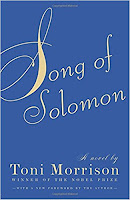
Hunger is reoccurring motif in chapter 10 of Song of Solomon. Now I'm not talking about hunger in the sense that Milkman hasn't eaten a lot lately. At first glance, the reader may read it as simply Milkman's lack of food, but the meaning Toni Morrison has put behind his hunger is much deeper.  Milkman's extreme hunger in this passage represents the absence of material goods and wealth he has experienced during his journey. He is so used to having everything he could ever want and excess money that when he is without his father's money, he goes through withdrawal. His withdrawal symptoms are shown when he "[begins] to shake with hunger" and when "his stomach [is] in a spasm"(253). He thinks back to his breakfast with Mrs. Cooper which was not good enough to eat because he was drunk. This symbolizes his lack of appreciation for material goods (Mrs. Cooper's breakfast) due to the fact that he has always had enough money and never had to worry...

Peacock

Image
I'm sure by now we have all realized that Song of Solomon is chock-full of symbols and metaphors. Toni Morrison uses many different items to act as symbols throughout the book. One symbol that stood out to me is the Peacock that Guitar and Milkman come across. What makes this symbol stand out from the countless others within the novel is the fact that the Peacock represents something different for both characters. For Milkman, the Peacock represents "vanity," wealth, and beauty(179). It is the materialistic wealth Milkman desires and what he believes will make him happy. The fact that the Peacock "can't fly no better than a chicken" represents how wealth and status will not allow Milkman to "fly"(179). Money will not set Milkman free. For Guitar, the peacock symbolizes something very different. The peacock's wealth and beauty represents white people and their power due to money. The fact that Guitar wants to "catch it" and ...

Significance of Naming

Image
In Song of Solomon, Toni Morrison gives each of her characters a name that has a deeper meaning behind it. The character's names define their origin as well as parts of their past. Toni Morrison also chooses not to name certain minor characters. Their lack of a name represents their lack of significance because names imply importance in this novel.  Milkman's grandfather, Macon Dead (the first), was named by a drunk Yankee. When registering as a free man, the drunk Yankee mixed up his home town, Macon, with his first name. It's ironic that when he becomes a free man, he is still named by a white man. The Yankee also names his last name 'dead' when Milkman's grandfather says, "He's dead" in reference to his own father(53). Irony is shown in his last name because he is given a new life as a free man, but his last name is Dead.  Even though he was named by a white man, Macon Dead decides to keep his name. He kept the name because his wife "l...

Hope

Image
In my opinion, the most beautifully written line in The Great Gatsby is said when Gatsby and Daisy meet again for the first time. After touring his mansion, Gatsby says to Daisy, "if it wasn't for the mist we could see your home across the bay... You always have a green light that burns all night at the end of our dock." Throughout the novel, the green light represents hope for Daisy and Gatsby's future together. The symbol first emerges at the end of chapter I when Nick catches Gatsby as "he stretched out his arms" towards Daisy's house and the mysterious green light. The fact that Gatsby can see Daisy's green light in the distance represents the hope for a relationship that Gatsby can see in the future. For Gatsby, "his dream must have seemed so close that he could hardly fail to grasp it." He continued to try and 'reach' for the green light, for it seemed so close to him. However, the mist referenced to in the quote represe...

Living in the Past

Image
While a cliche, it is true that the past is in the past, and that's where it should stay. Allowing our past to consume our present and future will eat away at you. No matter how hard you try, you can neither go back in time to relive the past or recreate the same situations as the past. Each moment in time happens only once, and no matter how great it was, cannot be redone.  In  The Great Gatsby,  Jay Gatsby becomes obsessed with the relationship he and Daisy had in the past.  Both he and Daisy were in love with each other, but things ended when Gatsby left for war and Daisy found Tom, a man with more money. When Gatsby tries to win Daisy back, he attempts to impress her with his new found wealth in his enormous mansion. Daisy is in awe with Gatsby's luxuries and cries do to the fact that this is the life she could've lived if she had not married Tom.  After confessing their love for each other, Gatsby plans to t...

Propaganda vs Truth

Image
Nazi propaganda was a bias form of media and advertisement used to convince the German public to support the Nazi party and Hitler. These posters romanticized Germans and blamed Jews for all of their problems. Nazi soldiers and Hitler were seen as strong, courageous fighters while Jews were seen as criminals and outcasts of society. The propaganda does not portray the death camps or ghettos the Jews were forced into, for they only showed the positive images or soldiers fighting for a cause. Spiegelman uses his chapter title pages as a way to mock these Nazi propaganda posters. He shows the truth of Hitler's motives in ways that the propaganda does not. While Nazi posters show soldiers fighting and people celebrating, Spiegelman's chapter covers show the horrors the Jews went through and their suffering. The difference between Nazi propaganda and Spiegelman's chapter covers is highlighted in the images shown above. Both show people marching, but each provides a very d...

Where Past and Present Meet

Image
Even though Art Spiegelman did not experience the horrors of the holocaust first hand, he is still deeply affected by the aftershocks of it. His father is not the same person or father figure he would have been if he had not experienced the holocaust, and Art feels a sort of survivors guilt for not being with his father during that time. The past of Vladek, Art, and their family affects their day to day lives and the dynamic of their family as it intersects with the present. Spiegelman shows this intersection by use of circles throughout the novel.  The connection between the past and present is shown on page 58 of volume II. The middle comic strip shows Vladek turning in a circle for Art until in the final panel, Art has changed into the doctor judging Vladek's physical ability. Art's perceived changing of character both highlights the fact that Art was not a part of the holocaust with his father and represents the connection Art still has with the holocaust. Art feels ...

Serene Sanitarium

Image
During the holocaust, Artie and Anja experience horrors that no one should have to go through. They are dragged out of their homes and called "filthy jew[s]'(33) as well as forced to watch their own family members and loved ones killed or taken by Nazi's. Due to this trauma, Anja is taken to a sanitarium in order to recover from being "hysterical or depressed"(31). The sanitarium is drawn as a very serine place to be. Anja and Artie's stay "is [more] like a luxury hotel"(34) than an asylum. They are waited on by nurses and stay in a luxurious room. The sanitarium is the only place during the time period in which Artie's father is telling the story that all races are co-existing peacefully. The drawing shows bunnies, mice, elephants, horses, pigs, mouse, and countless other animals walking around the park-like area with each other. This shows that the only place that is a safe escape from the anti-semitic views is an insane asylum, w...

Naturally Evil or Naturally Nice?

Image
Are human beings naturally caring, nice people? Or are they born with the desire to please no one but themselves? These questions have been asked by philosophers and curious minds alike since the beginning of civilization. In "This is Water" by David Foster Wallace, Wallace has the extreme belief that all human beings are naturally selfish. It is humans' "natural default-setting"(234) to be self-centered and oblivious to the feelings of others. This is due to the fact that "there is no experience you've had that you were not at the absolute center of"(233). Whether it is your own birthday party or one for your friend, it is remembered through your own mind and viewpoint. You remember every events through your owns eyes, and even if you experience the same thing as someone else, you each have your own opinions and takeaways. If Wallace's belief that humans are selfish is true, does that make humans evil? Does seeing things through your ow...

Music is Power

Image
Whether it be jazz, rock, hip-hop, or classical, music has the ability to touch people in ways nothing else can. It can reach right into your soul and bring out your deepest fears, problems, or insecurities. It takes those troubles off your shoulders and carries them for you.  A while ago, a group of musicians were playing for a local nursing home. These musicians played the same songs they had been practicing for weeks and barely had to think about it. The individuals notes were played by muscle memory, and the music flowed right out of them.  During one of their more popular "old people" songs, a man began to sing along with them. The players were touched by the old man's sweet voice blending with the tune of their instruments, but overall, they didn't think about it much.  After their performance, the audience applauded and a few individuals personally thanked the musicians. One woman, the wife of the man who was singing, approached them teary eyed. She e...

Linear Cenotaph vs Nonlinear Narrative

Image
Linear cenotaphs portray the victims of war in order of death and do not include a corpse in their design. Nonlinear narratives, such as The Things They Carried, tell stories in order of amplitude of impact and portray soldiers as they were, rather than how they died. Linear cenotaphs do a better job of creating an equal memorial for all soldiers and are places designated to mourn; however, nonlinear narratives are more accurate. The order of stories in a nonlinear narrative increases the accuracy because it shows events in order of influence on the war. While most people want to see all soldiers created equally, this is simply not the case. It is far more accurate to acknowledge that some soldiers were more important than others, and some soldiers made more of an impact on others. Likewise, many people don't want to contemplate the horrors of war, but that doesn't mean they didn't happen. Nonlinear narratives show these horrors in a way linear cenotaphs do not. They ...